Job Titles and Classifications in the State of California

Overview
In the state of California, class specifications and job titles may not align with how you typically think about careers. This guide will help you understand the classifications system and how you can use it to identify opportunities related to your academic majors or skill areas.
Understanding Class Specifications
If you’re feeling confused by the job titles you’re seeing, that’s okay. You’re not alone!
State job titles are designed for standardization across government, which means they may not be what you’d expect. These standardized job titles you see in CalCareers are also known as class specifications.
What is a class specification?
In California state government, a class specification is an official job description that details what a particular job is – they are especially helpful for identifying the career level of a particular job. Each description includes a definition of the role, necessary knowledge and abilities, and required qualifications. Every job posted on CalCareers falls into one of the many class specifications available across agencies and career fields.
Some class specifications may fall into a series. Jobs that are part of a series may provide opportunities for advancement without changing departments or switching jobs. Exploring the broader series of a class specification you are interested in can help you better understand the career trajectory of that position.
What about the “Working Title”? What’s the difference between the working title and the class specification?
While the class specification is the standardized job title, the “working title” is how the listing agency might refer to a specific position.
Sometimes the agency doesn’t change the title at all, but often, the working title can give you more information about the details of a particular job, such as an “Analyst I” position with a working title of “Finance Services Analyst.”
Across career fields, the titles you see may look quite different than those in the private sector. Take a look at the table below for some job-title translations:
| California State Government | Private Sector Equivalent |
|---|---|
| Personnel Specialist | HR Coordinator or HR Specialist |
| Office Technician | Administrative Assistant or Office Coordinator |
| Staff Services Assistant | Project Coordinator or Operations Analyst |
| Information Officer I | Communications Specialist |
| Employment Program Representative | Career Services Advisor |
Sometimes, the class specification actually gives you a good sense of what the job is going to be about. Take “Investment Officer III, Public Employees’ Retirement System” or “Meat Food Inspector” for example. These titles are quite specific, and one of them is even tied to a specific agency.
But many other times, the title is vague and could apply to a variety of agencies and career fields. Take “Analyst II” for example — you could be:
- Implementing procurement policies for the Department of Toxic Substances Control
- Consulting on performance management issues for the Department of Social Services
- Supporting policy analysis and recommendations for the Department of Health Care Services
These positions have a meaningful impact, but the details of the day-to-day work may be hidden behind a generic-sounding title. This is why it is important to explore available class specifications (and to always read the full job posting).
How can you find the best class specifications for you?
Identifying the most relevant class specifications starts with your area of interest. For additional exploratory resources, visit the California Career Guides.
Take your time exploring and read through each description carefully. As you go, take note of the class specifications that most interest you.
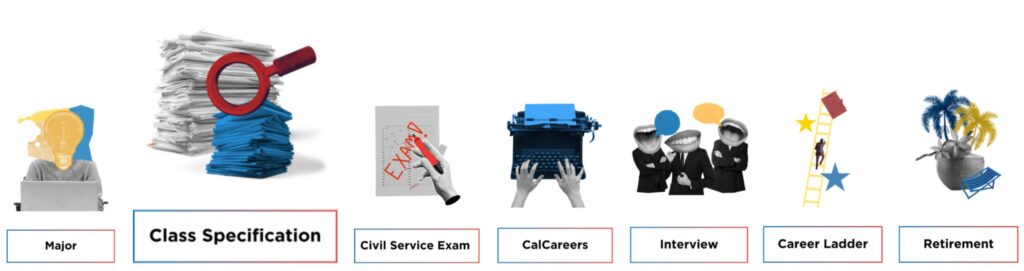
Using your desired career field as a guide, you can explore classifications. CalHR offers a search portal that allows you to explore all of the available class specifications. You can start by using keywords to narrow down results, such as “environmental,” “policy” or “communications.” By using the keyword search, you can find relevant results even if the titles aren’t what you expect.
Take your time exploring and read through each description carefully. As you go, take note of the class specifications that most interest you.
What’s next? Using Class Specifications
Once you’ve found a few class specifications you would like to pursue, you will head to CalCareers where you will use the information to narrow your search.